 Image 1 of 3
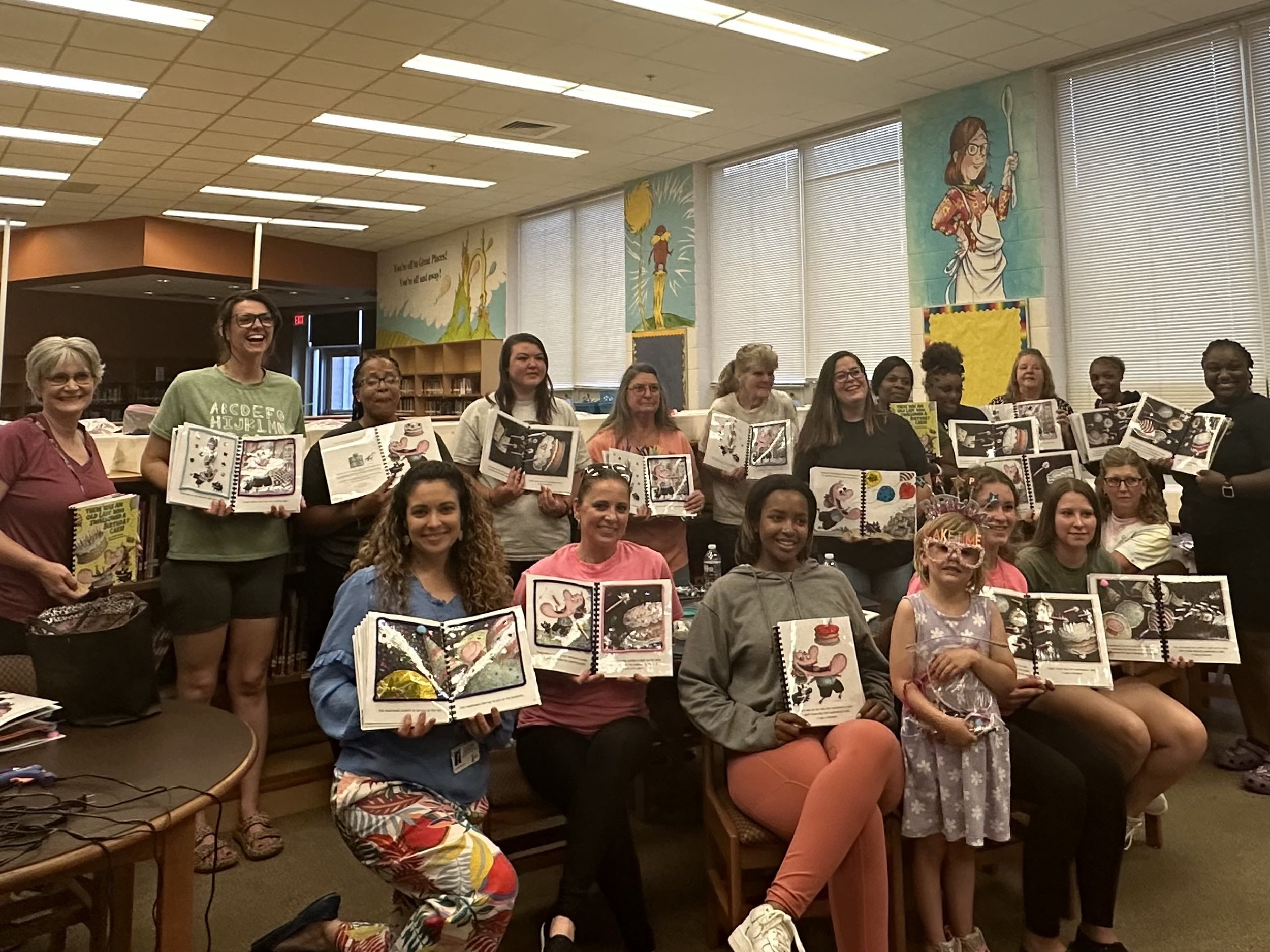 Image 2 of 3
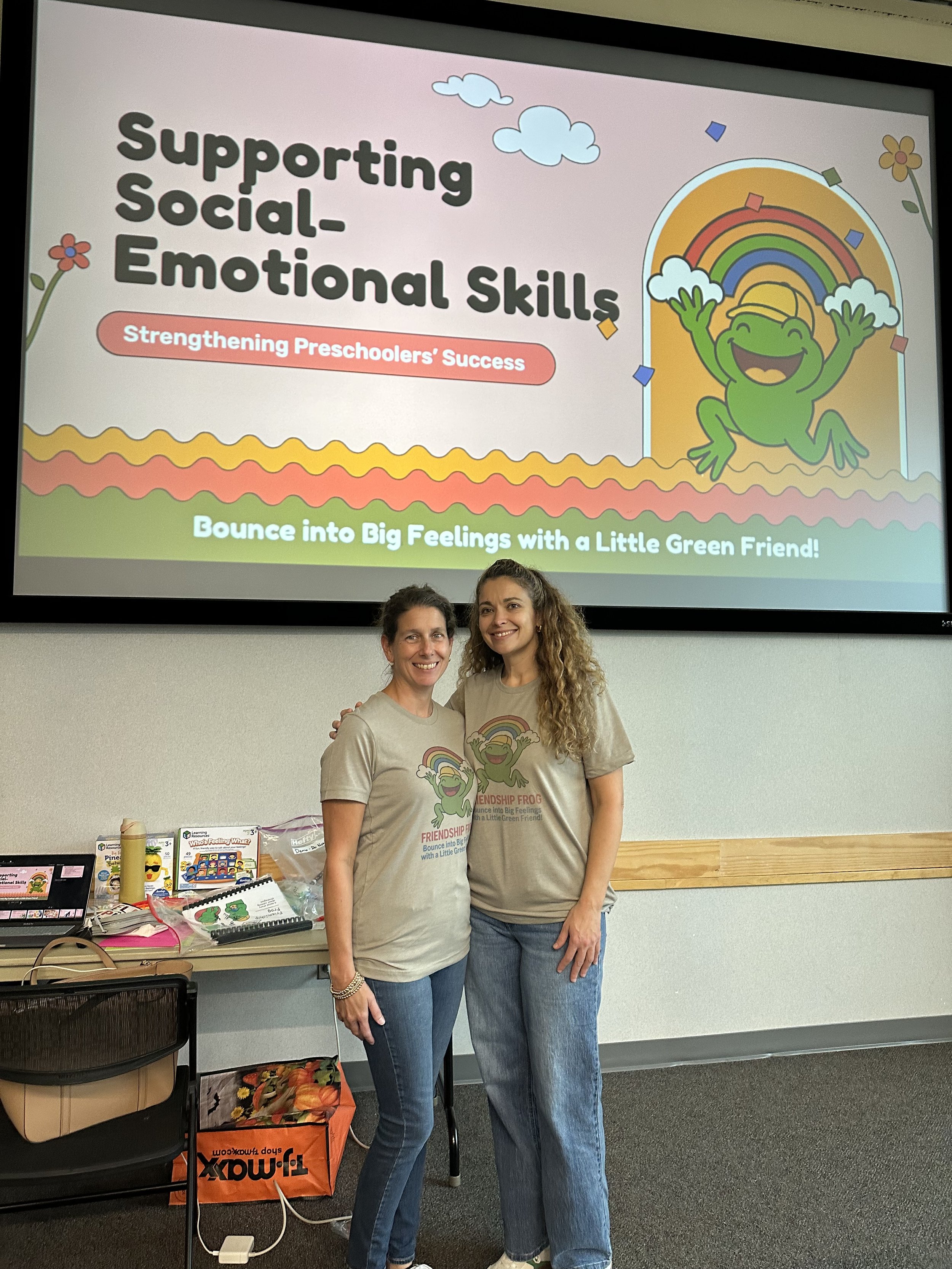 Image 3 of 3
Early Childhood Teacher/ Childcare Provider Workshop (2-hour session)
Choose from any session below and use the contact tab to email me your choice. You can also email me before purchasing if there is a specialized session you would like me to create for your group.
1. Bounce into Big Feelings: Supporting Social-Emotional Skills in Preschoolers
Social-emotional development is the foundation for success in all areas of early learning. In this interactive training, participants will explore strategies to nurture preschoolers’ social-emotional skills through meaningful play, co-regulation, and inclusive practices. Using the engaging “Friendship Frog” social stories and hands-on activities, we will dive into the five core components of social-emotional learning: self-awareness, self-management, social awareness, relationship skills, and responsible decision-making. Participants will learn why social-emotional development is essential for early learning, how to align practices with the Maryland Early Learning Standards in the social-emotional domain,, practical co-regulation techniques to help children manage big feelings, ways to create play-based opportunities that foster emotional growth and peer relationships, strategies for supporting children with diverse learning needs, and ow to integrate calming routines and visual supports into daily practice. This session includes hands-on exploration of materials, modeling of calming strategies, and collaborative reflection. By the end, providers will leave with actionable tools and resources to create nurturing environments where every child feels safe, connected, and ready to learn.
2. Curious Minds at Play: Building Initiative and Executive Functioning in Early Learners
Approaches to Learning are the foundation for lifelong success. This interactive training will explore how childcare providers can foster initiative, curiosity, and executive functioning skills in young children through play-based experiences and intentional teaching strategies. Participants will dive into the Maryland Early Learning Standards for Approaches to Learning and discover practical ways to integrate these skills into daily routines. Through engaging stories like Curious Crow and Mixed Up Monkey, hands-on activities, and collaborative discussions, participants will learn what Approaches to Learning are and why they matter for school readiness. how to nurture initiative and curiosity through invitations to play, the role of executive functioning skills—such as working memory, impulse control, and cognitive flexibility—in early learning, and strategies for creating environments that encourage exploration and problem-solving. This session includes reflection exercises, group challenges, and real-world examples to help providers design classrooms that spark curiosity and support children’s ability to think, plan, and adapt.
3. Language and Literacy in Little Learners
This interactive session will equip childcare providers with effective strategies to build language and literacy skills in preschool-aged children. Participants will explore how to create language-rich environments through storytelling, conversations, and playful learning. The session will highlight the importance of vocabulary development, phonological awareness, and early print concepts. Attendees will also learn how to support dual language learners and incorporate culturally responsive practices. By the end, providers will walk away with practical tools to foster confident, early communicators and readers. The puppet characters, Language Llama and Literacy Lion, will be utilized as part of the professional development to model effective developmentally appropriate engage for young learners.
4. Playful Pathways to Problem-Solving: Early Cognition & STEAM
This interactive training will help childcare providers explore strategies to nurture early cognition and STEAM skillsin children from birth to age four. Participants will learn how to support memory, problem-solving, and symbolic representation through playful learning experiencesthat integrate science, technology, engineering, arts, and mathematics. The session emphasizes hands-on exploration, open-ended questioning, and culturally responsive dramatic play to foster curiosity, persistence, and creativity. Providers will discover ways to embed math and science concepts—such as counting, patterning, spatial reasoning, and cause-and-effect—into daily routines and playful investigations. Inclusive practices, including Universal Design for Learning (UDL) and multilingual supports, will be highlighted to ensure all children can engage meaningfully and express their understanding in diverse ways.
5. Sensory Sparks and Strong Starts: Supporting Physical Well-Being and Motor Skills
This interactive training will equip childcare providers with practical strategies to promote physical well-being and motor development in alignment with the Maryland Early Learning Standards. Participants will explore the developmental progression of sensory integration, fine motor skills, gross motor coordination, and health routinesfortoddlers and preschool-aged children. Participants will make-and-take hands-on activities to engage young children in playful opportunities to promote sensory integration and motor skill development.
6. Top 10 Tips for Early Childhood Success
This professional development session will explore effective tools and strategies to engage all learners in early childhood settings through systems and routines. Participants will receive tools to enhance their social emotional skills including social stories, visual cues, and calming routines. The session will focus on creating child-centered climates that foster belonging and are differentiated to children’s developmental needs to cultivate action engagement and increase expected behaviors.
7. The Power of Play
Through this hands-on session participants will explore thematic playful learning materials. They will align the activities with the Maryland Learning Standards and plan ways to implement playful learning in their classrooms and childcare settings. Participants will walk away with a list of ideas and access to resource links they can implement right away.
8. Playful Learning for Pennies
The word is out! There is power in purposeful play throughout the day. Current research supports that more brain connections and skills are learned through play than relying heavily on teacher-led learning routines. We all want what’s best for children, but commercially available play-based learning materials can be both expensive and limited in purpose. Creating skillfully designed developmentally appropriate play-based learning activities for all children doesn’t have to cost a small fortune. Participants will walk away with practical knowledge and concrete tools to begin transforming dollar store items into classroom treasures to create integrated and thematic play-based experiences that target early learning standards across domains. Scaffolds and adaptations to materials will be highlighted to ensure all children have access and opportunities to playful learning matched with their cultural, linguistic, and ability needs. Ways to repurpose materials for multiple learning opportunities through play will be shared to allow personal motivations and interests to increase engagement and meaning for all children. Participants will never shop the same way after seeing the interdisciplinary hands-on multisensory play experiences created on a budget.
9. Little People, Big Behaviors
Kids do well if they can!Come learn how to proactively address problematic behaviors through identifying lagging skills and collaborative problem solving.Explore visual supports, seating solutions, and social stories to meet children’s needs. You will leave with tools to transform your classroom environment and solve problems to increase expected behaviors.
10. Story Time Success
Come learn 3 ways to read with children.Make story time an anticipated part of the day with interactive elements, nursery rhymes, and props.Leave ready to teach about print awareness, an important literacy sill that builds school success.You will create nursery rhyme props to bring back to your childcare center or classroom.
11. It’s Adaptable!
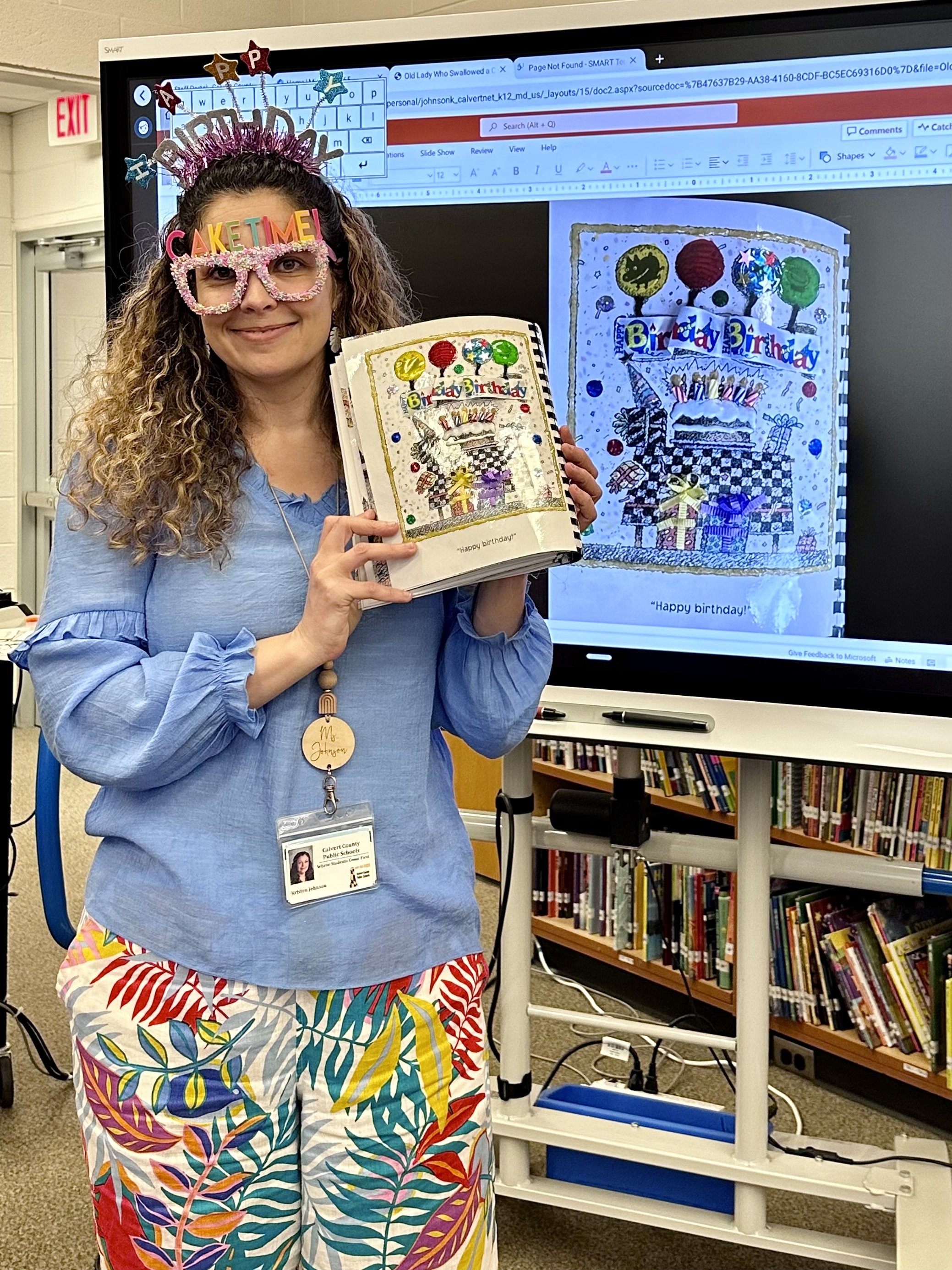
Do you ever feel like your story time isn’t reaching all the children in the room?If so, come adapt books with interactive elements including textures, retelling pieces, and various sensory elements to engage all learners.You will leave the session with an adapted book so you will be ready for story time success the very next day!This session should be done after Story Time Success or as a longer (at least 3 hour session) combined with Story Time Success. There is an additional cost of $15 per person for this session to cover materials costs.
12. Fine Motor Fun
With more time spent in front of screens, children are losing ground in their fine motor development.Explore hands-on activities to develop fine motor skills through play-based learning.You will leave the session with some activities ready to use in your classroom right away.
13. Seasonal Sensory Plan
Let it snow (in the classroom?!?).Let yourself explore the world through the eyes of a child while exploring hands-on sensory play for each season.Leave ready to engage all children in sensory experiences related to the season.You will make-and-take activities for your classroom to put your learning in practice. *Participants will receive 1 make-and-take as part of session cost. Additional make-and-takes will be for sale.
14. Constructing Competence Through Play
Mr. Rogers said “Play is often talked about as if it were relief from serious learning.But, for children, play is serious learning.Play is really the work of childhood.” Construct competence in developing children’s skills across all domains of early learning through facilitated and well-designed play.Participants will plan for developmental centers and leave with materials to add to their centers to increase student engagement while constructing our competence in questioning during child-centered play.
15. Making Story Time Count: Building Number Sense in Everyday Routines
Did you know that math is just as important as early literacy in predicting later school success?Come learn how to incorporate math skills into story time and other daily routines to build children’s understanding of math and language concepts.
16. Everyday Routines to Build Independence
Come learn how to increase children’s independence in daily routines using picture schedules, social stories, and by breaking activities into smaller chunks. Learn how you can use developmentally appropriate calendars and schedules to predict changes in routines and special events to ease transitions and anxiety.
17. I Am a Mathematician!
Construct competence in increasing counting and cardinality skills for all learners.This session will overview counting collections, using the Learning Trajectories to differentiate instruction, and fostering language and mathematical reasoning through daily Number Sense Routines.Participants will walk away with hands-on materials to begin counting collections and building number sense from the start of the school year.
18. Early Childhood Is Out of This World
Explore the benefits of thematic units and play through emersion in a space theme. Research-based strategies for hands-on developmentally appropriate learning will be highlighted. Participants will analyze over 20 thematic activities and relate them to the Maryland Early Learning Standards. Ways to engage children with diverse learning needs will be discussed. Participants will have the opportunity to make-and-take thematic activities. *Theme activities and kits will be for sale.
19. Building Communication and Attention Skills Through Story Time Routines
Learn how to help children construct meaning from their experiences and support their language learning through story time routines. The importance of, and how to embed, joint attention learning opportunities will be shared. Ways to intentionally deliver opportunities for children to respond to joint attention cues and initiate joint attention will be focused on within daily early childhood classroom routines. Participants will leave with tools to transform their story time to engage all children, especially those with communication and attention needs.
20. ABCs of Behavior
Do you ever feel like you’ve hit a wall when it comes to managing behavior? This session will help you learn to collect meaningful data that is used to find the function of the behavior to plan proactive and collaborative solutions. It’s as easy as ABC! Participants will practice analyzing data collected in early childhood programsto find the function. Strategies aligned with various functions will be highlighted.
21. The Blippi Effect
Have you ever thought children are different these days? Well, you’re right! Learn about the impact of technology on young children’s brains. However, we can leverage their fast-moving thinking to build stronger brains. Participants will learn ways to engage children in hands-on playful activities to build strong neural connections without the use of technology. Tools to share with families will be provided.
Choose from any session below and use the contact tab to email me your choice. You can also email me before purchasing if there is a specialized session you would like me to create for your group.
1. Bounce into Big Feelings: Supporting Social-Emotional Skills in Preschoolers
Social-emotional development is the foundation for success in all areas of early learning. In this interactive training, participants will explore strategies to nurture preschoolers’ social-emotional skills through meaningful play, co-regulation, and inclusive practices. Using the engaging “Friendship Frog” social stories and hands-on activities, we will dive into the five core components of social-emotional learning: self-awareness, self-management, social awareness, relationship skills, and responsible decision-making. Participants will learn why social-emotional development is essential for early learning, how to align practices with the Maryland Early Learning Standards in the social-emotional domain,, practical co-regulation techniques to help children manage big feelings, ways to create play-based opportunities that foster emotional growth and peer relationships, strategies for supporting children with diverse learning needs, and ow to integrate calming routines and visual supports into daily practice. This session includes hands-on exploration of materials, modeling of calming strategies, and collaborative reflection. By the end, providers will leave with actionable tools and resources to create nurturing environments where every child feels safe, connected, and ready to learn.
2. Curious Minds at Play: Building Initiative and Executive Functioning in Early Learners
Approaches to Learning are the foundation for lifelong success. This interactive training will explore how childcare providers can foster initiative, curiosity, and executive functioning skills in young children through play-based experiences and intentional teaching strategies. Participants will dive into the Maryland Early Learning Standards for Approaches to Learning and discover practical ways to integrate these skills into daily routines. Through engaging stories like Curious Crow and Mixed Up Monkey, hands-on activities, and collaborative discussions, participants will learn what Approaches to Learning are and why they matter for school readiness. how to nurture initiative and curiosity through invitations to play, the role of executive functioning skills—such as working memory, impulse control, and cognitive flexibility—in early learning, and strategies for creating environments that encourage exploration and problem-solving. This session includes reflection exercises, group challenges, and real-world examples to help providers design classrooms that spark curiosity and support children’s ability to think, plan, and adapt.
3. Language and Literacy in Little Learners
This interactive session will equip childcare providers with effective strategies to build language and literacy skills in preschool-aged children. Participants will explore how to create language-rich environments through storytelling, conversations, and playful learning. The session will highlight the importance of vocabulary development, phonological awareness, and early print concepts. Attendees will also learn how to support dual language learners and incorporate culturally responsive practices. By the end, providers will walk away with practical tools to foster confident, early communicators and readers. The puppet characters, Language Llama and Literacy Lion, will be utilized as part of the professional development to model effective developmentally appropriate engage for young learners.
4. Playful Pathways to Problem-Solving: Early Cognition & STEAM
This interactive training will help childcare providers explore strategies to nurture early cognition and STEAM skillsin children from birth to age four. Participants will learn how to support memory, problem-solving, and symbolic representation through playful learning experiencesthat integrate science, technology, engineering, arts, and mathematics. The session emphasizes hands-on exploration, open-ended questioning, and culturally responsive dramatic play to foster curiosity, persistence, and creativity. Providers will discover ways to embed math and science concepts—such as counting, patterning, spatial reasoning, and cause-and-effect—into daily routines and playful investigations. Inclusive practices, including Universal Design for Learning (UDL) and multilingual supports, will be highlighted to ensure all children can engage meaningfully and express their understanding in diverse ways.
5. Sensory Sparks and Strong Starts: Supporting Physical Well-Being and Motor Skills
This interactive training will equip childcare providers with practical strategies to promote physical well-being and motor development in alignment with the Maryland Early Learning Standards. Participants will explore the developmental progression of sensory integration, fine motor skills, gross motor coordination, and health routinesfortoddlers and preschool-aged children. Participants will make-and-take hands-on activities to engage young children in playful opportunities to promote sensory integration and motor skill development.
6. Top 10 Tips for Early Childhood Success
This professional development session will explore effective tools and strategies to engage all learners in early childhood settings through systems and routines. Participants will receive tools to enhance their social emotional skills including social stories, visual cues, and calming routines. The session will focus on creating child-centered climates that foster belonging and are differentiated to children’s developmental needs to cultivate action engagement and increase expected behaviors.
7. The Power of Play
Through this hands-on session participants will explore thematic playful learning materials. They will align the activities with the Maryland Learning Standards and plan ways to implement playful learning in their classrooms and childcare settings. Participants will walk away with a list of ideas and access to resource links they can implement right away.
8. Playful Learning for Pennies
The word is out! There is power in purposeful play throughout the day. Current research supports that more brain connections and skills are learned through play than relying heavily on teacher-led learning routines. We all want what’s best for children, but commercially available play-based learning materials can be both expensive and limited in purpose. Creating skillfully designed developmentally appropriate play-based learning activities for all children doesn’t have to cost a small fortune. Participants will walk away with practical knowledge and concrete tools to begin transforming dollar store items into classroom treasures to create integrated and thematic play-based experiences that target early learning standards across domains. Scaffolds and adaptations to materials will be highlighted to ensure all children have access and opportunities to playful learning matched with their cultural, linguistic, and ability needs. Ways to repurpose materials for multiple learning opportunities through play will be shared to allow personal motivations and interests to increase engagement and meaning for all children. Participants will never shop the same way after seeing the interdisciplinary hands-on multisensory play experiences created on a budget.
9. Little People, Big Behaviors
Kids do well if they can!Come learn how to proactively address problematic behaviors through identifying lagging skills and collaborative problem solving.Explore visual supports, seating solutions, and social stories to meet children’s needs. You will leave with tools to transform your classroom environment and solve problems to increase expected behaviors.
10. Story Time Success
Come learn 3 ways to read with children.Make story time an anticipated part of the day with interactive elements, nursery rhymes, and props.Leave ready to teach about print awareness, an important literacy sill that builds school success.You will create nursery rhyme props to bring back to your childcare center or classroom.
11. It’s Adaptable!
Do you ever feel like your story time isn’t reaching all the children in the room?If so, come adapt books with interactive elements including textures, retelling pieces, and various sensory elements to engage all learners.You will leave the session with an adapted book so you will be ready for story time success the very next day!This session should be done after Story Time Success or as a longer (at least 3 hour session) combined with Story Time Success. There is an additional cost of $15 per person for this session to cover materials costs.
12. Fine Motor Fun
With more time spent in front of screens, children are losing ground in their fine motor development.Explore hands-on activities to develop fine motor skills through play-based learning.You will leave the session with some activities ready to use in your classroom right away.
13. Seasonal Sensory Plan
Let it snow (in the classroom?!?).Let yourself explore the world through the eyes of a child while exploring hands-on sensory play for each season.Leave ready to engage all children in sensory experiences related to the season.You will make-and-take activities for your classroom to put your learning in practice. *Participants will receive 1 make-and-take as part of session cost. Additional make-and-takes will be for sale.
14. Constructing Competence Through Play
Mr. Rogers said “Play is often talked about as if it were relief from serious learning.But, for children, play is serious learning.Play is really the work of childhood.” Construct competence in developing children’s skills across all domains of early learning through facilitated and well-designed play.Participants will plan for developmental centers and leave with materials to add to their centers to increase student engagement while constructing our competence in questioning during child-centered play.
15. Making Story Time Count: Building Number Sense in Everyday Routines
Did you know that math is just as important as early literacy in predicting later school success?Come learn how to incorporate math skills into story time and other daily routines to build children’s understanding of math and language concepts.
16. Everyday Routines to Build Independence
Come learn how to increase children’s independence in daily routines using picture schedules, social stories, and by breaking activities into smaller chunks. Learn how you can use developmentally appropriate calendars and schedules to predict changes in routines and special events to ease transitions and anxiety.
17. I Am a Mathematician!
Construct competence in increasing counting and cardinality skills for all learners.This session will overview counting collections, using the Learning Trajectories to differentiate instruction, and fostering language and mathematical reasoning through daily Number Sense Routines.Participants will walk away with hands-on materials to begin counting collections and building number sense from the start of the school year.
18. Early Childhood Is Out of This World
Explore the benefits of thematic units and play through emersion in a space theme. Research-based strategies for hands-on developmentally appropriate learning will be highlighted. Participants will analyze over 20 thematic activities and relate them to the Maryland Early Learning Standards. Ways to engage children with diverse learning needs will be discussed. Participants will have the opportunity to make-and-take thematic activities. *Theme activities and kits will be for sale.
19. Building Communication and Attention Skills Through Story Time Routines
Learn how to help children construct meaning from their experiences and support their language learning through story time routines. The importance of, and how to embed, joint attention learning opportunities will be shared. Ways to intentionally deliver opportunities for children to respond to joint attention cues and initiate joint attention will be focused on within daily early childhood classroom routines. Participants will leave with tools to transform their story time to engage all children, especially those with communication and attention needs.
20. ABCs of Behavior
Do you ever feel like you’ve hit a wall when it comes to managing behavior? This session will help you learn to collect meaningful data that is used to find the function of the behavior to plan proactive and collaborative solutions. It’s as easy as ABC! Participants will practice analyzing data collected in early childhood programsto find the function. Strategies aligned with various functions will be highlighted.
21. The Blippi Effect
Have you ever thought children are different these days? Well, you’re right! Learn about the impact of technology on young children’s brains. However, we can leverage their fast-moving thinking to build stronger brains. Participants will learn ways to engage children in hands-on playful activities to build strong neural connections without the use of technology. Tools to share with families will be provided.